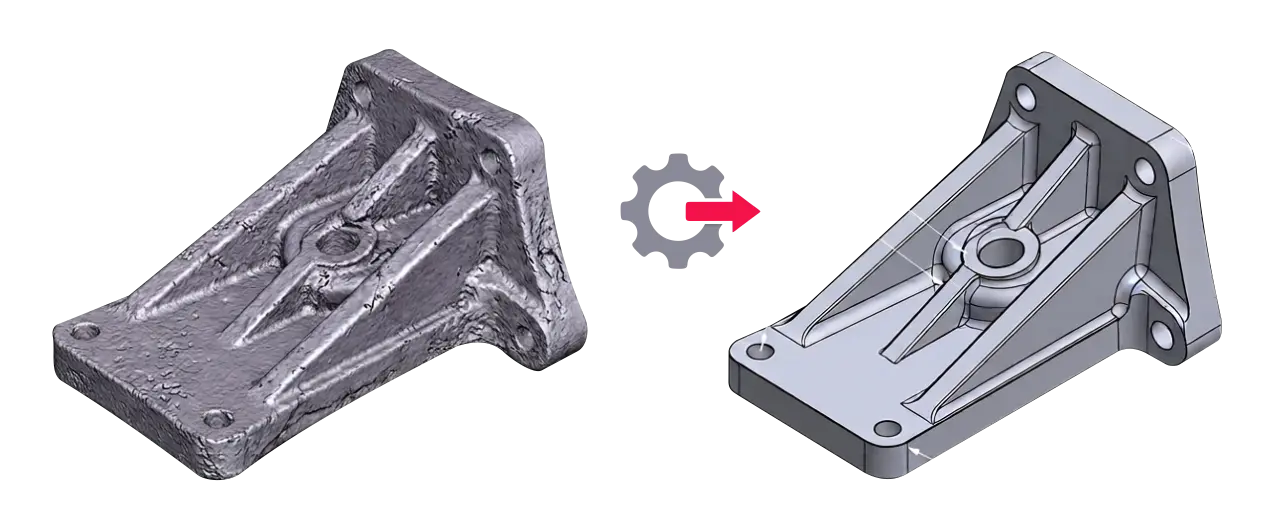
Already have an STL, OBJ, or point-cloud scan? I'll reverse-engineer it into a clean, fully-dimensioned, editable parametric model ready for machining, molding, or redesign.
Overview
This comes up more often than people expect: a legacy part with no digital record, an OEM component you need to replicate or modify, a competitor product you're benchmarking, or a broken part for equipment that's been discontinued for a decade. In every case, the starting point isn't a clean CAD file — it's a raw 3D scan or mesh.
This service handles the scan side: I take your mesh — from your own 3D scanner or one I arrange — and rebuild it as a genuine parametric solid model, not a static surface copy of the scan data, but a real, feature-based CAD file with dimensions, tolerances, and design intent baked in. Don't have a scan yet, only the physical part? See Physical Part to CAD instead — that path starts from precision measurement rather than an existing scan file.
Typical inputs I work from:
How It Works
Receive your mesh file. Assess scan quality, missing detail, and identify critical features and datum surfaces before any modeling starts.
Clean scan noise, fill holes, decimate where needed, and align the mesh to a proper coordinate system and datum structure.
Rebuild the part as a true feature-tree solid — extrudes, revolves, fillets, patterns — with real dimensions, not a dumb surface trace of the mesh.
Overlay the new model against the original scan to confirm deviation is within tolerance, then deliver native and neutral-format files.
What You Get
Feature-tree CAD in SolidWorks or Fusion 360 — real, editable features and dimensions, not a static mesh or dumb surface body.
A deviation analysis overlaying the final model against your original scan, so you know exactly how tight the rebuild is.
2D drawings with GD&T callouts, suitable for machining, molding, or incoming-inspection QC.
STEP, IGES, and native SolidWorks/Fusion source files — whatever your downstream tools need.
FAQ
STL, OBJ, PLY, and raw point clouds from most structured-light or laser scanners.
Yes, but that's a separate service — see Physical Part to CAD. Ship the part directly (or I arrange scanning) and I measure it myself instead of working from an existing scan.
A true parametric solid model — real features, real dimensions, editable like any CAD file designed from scratch. A dumb surface trace of the mesh isn't useful for machining or molding, so that's never the deliverable.
Yes. Worn features get reconstructed to their likely original design intent using surrounding geometry and any reference dimensions you can provide, rather than modeling the damage itself.
Yes — this is a common request. If you want dimensional or material changes for a new manufacturing process, let me know before the rebuild starts so the parametric structure supports the change.
Cost scales with part complexity — feature count, surface type, and tolerance requirements — not just physical size. Send the scan and you'll get a fixed-price quote, usually within an hour, so there are no surprises mid-project.